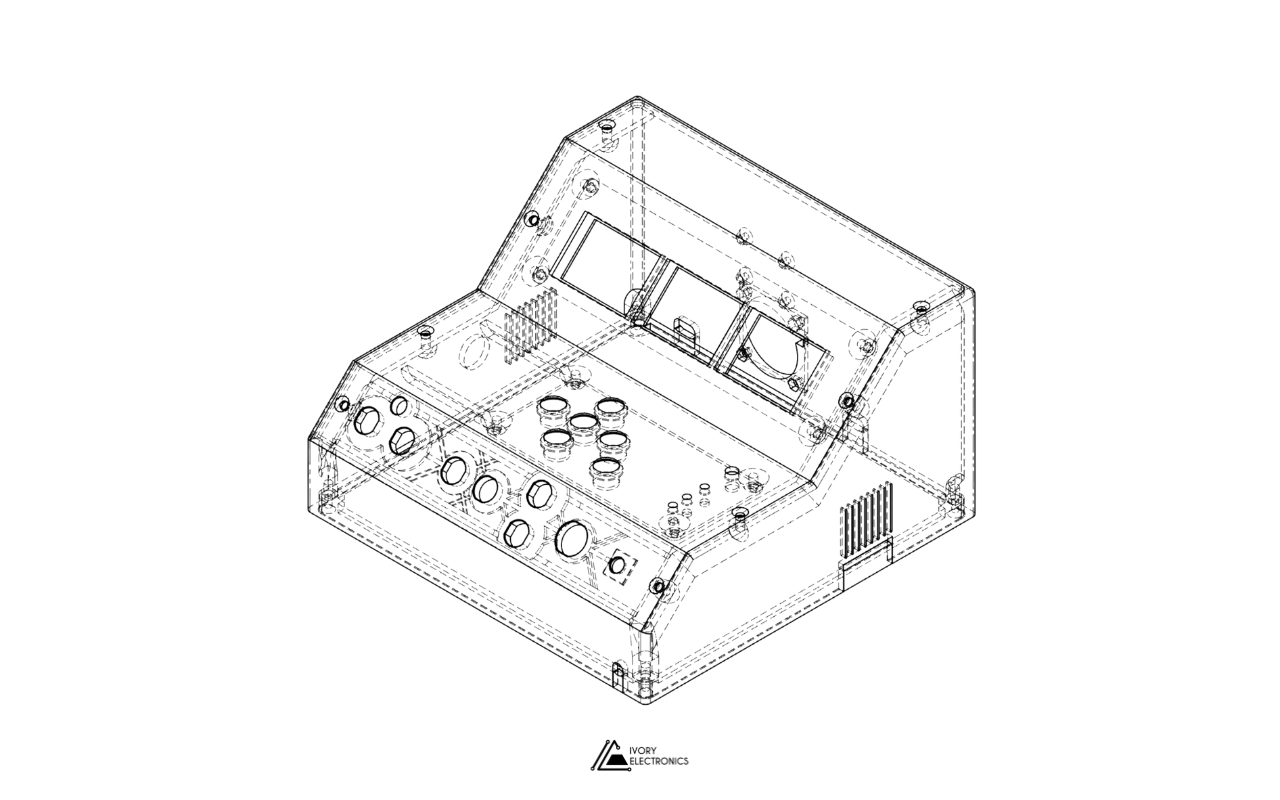
Designing an integrated instrument for the teaching and research lab In many labs, an electrochemistry experiment still means a familiar scene: a bench supply, a multimeter or two, a conductivity meter, a thermometer, and a tangle of leads connecting them. Every instrument has its own display, its own quirks and its own way of recording (or not recording) data. We were asked to fold that bench into one instrument for university-level teaching and research work. The electronics are designed, built and validated on the bench. Here is what went into it, and why it was harder than it looks. One box, many jobs The instrument brings together, on a single two-layer board: Each function is textbook on its own. Making them coexist on one board, sharing one supply, is where the engineering happens. Hurdle 1: Mixed-signal on two layers A two-layer board keeps cost down, but it removes the luxury of a solid ground plane under everything. Here, a power stage that can carry hundreds of milliamps shares the board with millivolt-level measurement signals. We split the design into three ground domains (analog, digital and power) and joined them deliberately with net ties, so return currents from the output stage and the digital logic do not flow through the analog reference. The design is organised into digital and analogue sections, keeping the sensitive front ends away from the power paths. Power comes in over USB-C Power Delivery, negotiated at 12 V, with a TVS clamp at the input and a supply-health signal back to the controller. From there, dedicated regulators generate the logic rails, separate analog rails and a symmetric ± supply for the circuits that need to swing both sides of ground. Hurdle 2: A current limit that has to survive itself Electrochemical cells are unforgiving loads: an electrode short or a misconnected lead can ask for far more current than the experiment needs. The output therefore has a real current clamp: a sense resistor, an error amplifier and a MOSFET that regulates linearly to hold the current at a limit that the firmware sets through a DAC. A separate comparator watches for overload and raises a digital flag, which firmware turns into an audible alarm. The catch with linear regulation is heat. At the limit, the MOSFET absorbs the entire difference between the supply and the load voltage. Semiconductor vendors warn that linear-mode operation is exactly where MOSFETs are most fragile: below the zero-temperature-coefficient point, a hotter region of the die draws more current and gets hotter still, which can end in thermal runaway. Nexperia’s application note on the subject shows one device whose usable current at 20 V dropped by about 75% compared with the simple theoretical figure. We designed a custom footprint so that the MOSFET could be pressed against an aluminium heat-spreading slab, instead of relying on copper area alone. Hurdle 3: Measuring conductivity without destroying the sample Conductivity looks like a resistance measurement, but DC is the wrong tool. As Analog Devices puts it, applying DC to the electrodes lets ions accumulate on their surfaces, causing “polarization, measurement errors, and damage to the electrode.” The same article points out two more traps: a single cell can present anything from about 30 Ω in seawater to 1 MΩ in pure water, and conductivity changes by up to 4% per °C. Our conductivity channel drives the probe with an AC excitation derived from an on-board oscillator, conditions the result with op-amps powered from the symmetric supply, and hands a clean signal to the ADC. Because temperature matters so much, the instrument also has an NTC temperature channel, so readings can be compensated in firmware rather than taken at face value. Hurdle 4: Current measurement in both directions In electrochemistry, current direction carries meaning. The ammeter channel uses a low-value shunt and a current-sense amplifier biased around a precision mid-scale reference, so current in either direction lands inside the ADC’s input range. The channel is fused through an external, user-replaceable fuse holder, so a blown fuse is a quick swap rather than a repair job. Usability: an instrument, not a dev board A lab instrument is judged by the person using it, not by the person who designed it. That shaped several decisions: Built to be brought up, and serviced Two-layer and cost-conscious does not have to mean hard to debug. The board carries 45 labelled test points across the supply rails, references and signal chain, plus jumpers on the main supply rails for bring-up. A JTAG header and an internal debug UART give firmware engineers full visibility. When something needs checking during bring-up or in the field, the answer is a probe tip away. How we work As with all our projects, the design lives in KiCad as hierarchical sheets, one per functional block, under Git version control. Datasheets and reference designs sit in the repository next to the schematic, and design calculations (gains, thresholds, reference levels) are written onto the schematic itself, so the reasoning travels with the design. The result The boards have been manufactured and validated on the bench: power negotiation, regulated rails, the current-limited output, and the measurement, display and logging chain all working together. If you have a lab workflow that deserves better than a pile of separate instruments, or any measurement problem that mixes precision analog, power and a usable interface, we would like to hear about it. Visit www.ivory-electronics.com

Unlocks Dynamic Control of Terahertz Waves with Advanced Instrumentation
Custom Electronics Enable Tunable Reflection and Transmission of THz Light for Imaging, Sensing, and Communication https://www.nature.com/articles/s41467-025-58256-w Engineering the Future of THz Technology Ivory Electronics is proud to be at the forefront of terahertz (THz) and millimeter wave innovation. Our latest achievement? Developing electronics instrumentation that dynamically controls THz wave behavior—opening new possibilities in imaging, sensing, and high-frequency communications. This breakthrough demonstrates how precise voltage modulation across layered materials like PET, graphene, and electrolytes can manipulate THz reflection and transmission patterns over large areas. Tunable THz Electronics for Real-World Applications Our demonstrator system showcases how THz light can be programmed for specific reflection and transmission profiles. This capability is critical for applications ranging from security scanning and biomedical imaging to next-gen wireless communication. Key features include: The system visualizes THz wave interference, pattern generation, and even imaging capabilities—highlighting the versatility of our instrumentation. Precision Meets Scalability The mathematical modeling and real-world testing of our system validate its performance across THz frequencies. With phase and amplitude control, our electronics enable dynamic wave shaping, essential for adaptive sensing and reconfigurable communication systems.

Electronics for Textile Sensors: AI-Driven Smart Fabric for Pressure Ulcer Prevention
Advanced Embedded Electronics Enable Real-Time Pressure Mapping for Healthcare Innovation Smart Technology Meets Healthcare Ivory Electronics is proud to be part of a pioneering project that merges smart fabric technology with AI to tackle one of healthcare’s most persistent challenges—pressure ulcers. In collaboration with the University of South Wales (USW), our embedded electronics are helping transform how pressure injuries are monitored and prevented. This initiative, backed by Royce Industrial Collaboration funding, aims to reduce the burden of bedsores on healthcare systems like the NHS, potentially saving billions annually. Precision Pressure Monitoring with Smart Fabric Our team developed high-sensitivity embedded electronics that integrate seamlessly with smart fabrics to deliver accurate, real-time pressure data. The system visualizes pressure distribution across contact surfaces, enabling clinicians to assess risk and intervene early. Key features include: The technology generates metrics such as risk score, contact area, and peak pressure, offering actionable insights for patient care. Collaboration for Impact This project demonstrates how electronics consultancy can drive meaningful change in healthcare. By enabling AI-powered smart textiles, we’re helping researchers and clinicians develop proactive solutions for patient well-being. Whether it’s aerospace, medical, or industrial innovation, Ivory Electronics delivers robust, scalable instrumentation tailored to your mission. #Custom embedded systems for smart textiles #PCB design for sensor integration #Electronics for medical and industrial application

High-Reliability PCB Solutions for Extreme Altitude Missions
Custom Electronics Instrumentation Designed to Withstand Stratospheric Conditions and Enable Smart Thermal Control Engineering for the Edge of Space We thrive on pushing the limits of electronics design. One of the important milestone -Delivering custom PCB solutions and instrumentation that operate flawlessly in the stratosphere—where temperatures plummet and reliability is non-negotiable. In collaboration with SmartIR and Sent Into Space, our technology was part of a high-altitude balloon mission that tested smart radiators designed to control thermal radiation in extreme conditions. This achievement marks a critical step toward scalable space-grade electronics. Built for Harsh Environments Our engineering team developed electronics that not only survived but performed under stratospheric stress. These systems are tailored for aerospace and high-altitude applications, where conventional electronics often fail. Key features include: Supporting Innovation Beyond Earth This mission was more than a test—it was a demonstration of how advanced electronics can enable next-generation space technologies. SmartIR’s smart radiators, powered by our instrumentation, are paving the way for smarter thermal management in future satellite and space missions. We’re proud to support visionary companies like SmartIR and contribute to the future of aerospace innovation.

Revolutionizing Satellite Technology: Electronics Power Graphene-Based Smart Coating for Space Missions
Custom Electronics and PCB Design to Enable Advanced Thermal Control in Harsh Space Environments Pushing Boundaries in Space Innovation At Ivory Electronics, we specialize in cutting-edge electronics consultancy and custom instrumentation design. Our proud achievement- Collaborating on a groundbreaking satellite project that integrates a graphene-based smart coating—designed to control thermal radiation on demand in space. Engineering Excellence Behind the Smart Coating We proudly designed and developed the custom electronics instrumentation and PCB architecture that drives this revolutionary graphene-based emitter. This smart coating is not just a scientific marvel—it’s a practical solution for managing satellite temperature in the extreme conditions of space. Key innovations include: Launching with Global Leaders This technology has been tested in orbit via a PocketQube satellite mission in 2024, launched by SpaceX. The mission is led by SmartIR—a spin-out from the University of Manchester’s Graphene Engineering Innovation Centre (GEIC)—in partnership with Alba Orbital and Hydra Space. This collaboration highlights our role in enabling real-world applications of advanced materials through precise, reliable electronics design.